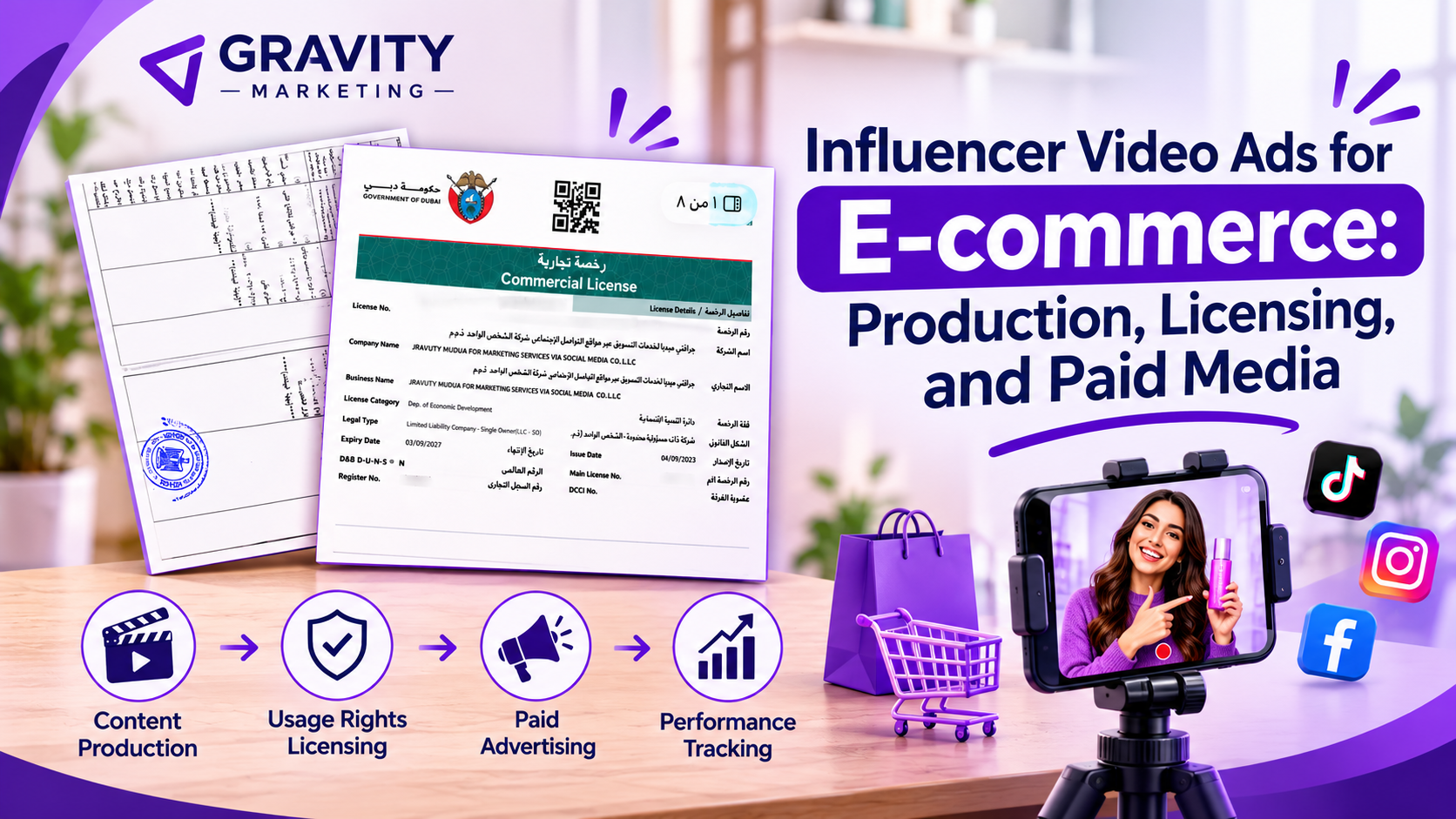
Introduction: Does your store need just another video, or an experience that convinces the customer to make a purchase
Why Do Some UGC Videos Fail to Achieve Their Goals
Revealing the Idea: What Does an E-commerce Store Actually Need from a UGC Content Production Company
4. The Execution Roadmap: How Does a UGC Production Company Work with an E-commerce Store
Delivering the Videos and Defining Usage Rights
The Surprise Element: Adding a Technological Layer
Conclusion: Choose a Company That Creates Content for Every Stage of the Customer Journey
Contact Gravity Marketing to Produce UGC Videos for Your E-commerce Store in Egypt
Introduction: Does your store need just another video, or an experience that convinces the customer to make a purchase
Let’s start by noting that customers encounter dozens of product advertisements every day—yet not every video succeeds in building trust in the product or prompting a purchase decision.
The Concept: The issue isn’t the number of videos; it’s their ability to showcase the product in a realistic way that answers the customer’s questions.
Join the Gravity Marketing Creator Network and discover collaboration opportunities with brands to produce UGC videos that fit your campaign needs and budget, while understanding content usage rights and available production options. Join the Gravity Marketing Creator Network
Why Do Some UGC Videos Fail to Achieve Their Goals
Not every visually appealing video can convince a customer to make a purchase. An e-commerce store may receive a video with high production quality and professional editing, yet it may fail to achieve its purpose if it does not present the product clearly or answer the questions customers have in mind.
The problem often comes down to five common mistakes:
1. An Attractive Video That Doesn't Show How to Use the Product
A video may focus on aesthetic shots and background music without demonstrating how to use the product or highlighting its important details. As a result, customers watch visually appealing content but don't get the information they need to make a purchase decision.
2. Choosing a Creator Who Doesn't Match the Store's Audience
Follower count alone is not enough to determine whether a creator is the right fit. If their style or audience doesn't align with the store's target customers, the video may feel irrelevant to their interests, even if the production quality is good.
3. Turning a User Experience into a Traditional Advertisement
One of the main advantages of UGC is that it presents a product from the perspective of a real user experience. However, when a video relies on a scripted promotional message and exaggerated product claims, it loses its natural feel and starts to resemble the traditional advertisements audiences are used to seeing.
4. Missing a Clear Call to Action (CTA)
A video may explain the product and highlight its features without telling customers what to do next. That's why the desired action should be defined according to the video's objective, whether it's visiting the product page, learning more about the product, or completing a purchase.
5. Failing to Define Video Usage Rights for Paid Advertising
Producing a video does not automatically mean the store has the right to use it across all channels and for every purpose. If usage rights are not clearly defined in advance, the store may face restrictions when republishing the content or using it in paid advertising campaigns. That's why the platforms, usage period, and scope of the license should be agreed upon before production begins.
Join the Gravity Marketing Creator Network and discover collaboration opportunities with brands to produce UGC videos that fit your campaign needs and budget, while understanding content usage rights and available production options. Join the Gravity Marketing Creator Network
Revealing the Idea: What Does an E-commerce Store Actually Need from a UGC Content Production Company
An e-commerce store doesn't need a large number of videos just to publish them on social media platforms. Instead, it needs content that presents its products in an authentic way, helps customers understand them, and answers their questions before they make a purchase decision.
For example, if a store sells skincare products, it may need a variety of videos, such as:
-
Unboxing Video: Introducing the product, its contents, and its packaging.
-
Product Demonstration Video: Explaining how to use the product and the steps involved.
-
Product Experience Video: Sharing the creator's personal impressions of using the product.
-
FAQ Video: Addressing common questions customers may have before making a purchase.
-
Product Features Video: Highlighting the product's key features and distinguishing details.
This is where a UGC Content Production Service comes in. Its role goes beyond filming and editing. It starts with understanding the product and target audience, then selecting suitable content creators, developing video concepts, preparing filming requirements, and ultimately producing content that supports the store's marketing objectives. Preparing a clear UGC brief helps define the required message, key shots, and product presentation before filming begins.
Rather than relying on a single video to communicate every detail, the store can distribute its messages across multiple videos, with each one serving a specific purpose in the customer's journey, from discovering the product to making a purchase decision.
Join the Gravity Marketing Creator Network and discover collaboration opportunities with brands to produce UGC videos that fit your campaign needs and budget, while understanding content usage rights and available production options. Join the Gravity Marketing Creator Network
4. The Execution Roadmap: How Does a UGC Production Company Work with an E-commerce Store
UGC content production doesn't start with a camera and filming right away. Instead, it involves several stages that help the production company understand the store's needs and turn them into videos that support its marketing objectives. The collaboration can be divided into five key steps:
1. Understanding the Product and Target Audience
The company begins by learning about the products the store offers, their key features, and the type of customers it wants to reach. It also identifies the content's main objective: Is the goal to introduce the product, explain how to use it, address customer hesitation, or encourage purchases?
The clearer this information is, the easier it becomes to determine the right video formats and messages.
2. Selecting the Right Content Creators
Once the store's needs are clear, the next step is to select creators who can present the product in a natural and convincing way. This decision should not be based on follower count alone. It should also consider the creator's filming and presentation style, how well their personality fits the product, and their ability to connect with the target audience.
3. Developing Ideas and Preparing the UGC Brief
The store's objectives are then translated into actionable video concepts. A UGC brief is prepared to explain the core message, required shots, product presentation, expected video length, and call to action (CTA).
It's important for the brief to define the essential requirements without forcing the creator to follow a fully scripted advertisement, allowing them to maintain their natural style. For more details, read How to Write a UGC Brief That Creators Can Actually Follow.
4. Filming, Editing, and Content Review
Once the concepts and production requirements are approved, creators begin filming the videos. The footage then goes through editing, including adding text or visual elements as needed for each video.
The content is reviewed afterward to ensure the product is clearly presented, the key messages are communicated, and the agreed requirements are met before delivery.
Delivering the Videos and Defining Usage Rights
In the final stage, the store receives the videos in the agreed formats and dimensions. The usage rights should also be clearly defined, including the platforms where the videos can be published, the licensing period, and whether the content can be used in paid advertising.
It's best to agree on these details before production begins so the store can plan how to reuse the content without facing unexpected restrictions.
Following these steps makes the UGC production process more organized. The store knows what to expect, the creator understands what is required, and the marketing concept becomes ready-to-use content across the store's different marketing channels.
Join the Gravity Marketing Creator Network and discover collaboration opportunities with brands to produce UGC videos that fit your campaign needs and budget, while understanding content usage rights and available production options. Join the Gravity Marketing Creator Network
The Surprise Element: Adding a Technological Layer
Developing UGC content doesn't stop at producing videos and delivering them to the store. Technology can add further value by analyzing content performance and identifying ideas worth repeating and improving.
After publishing the videos, the store can track performance metrics such as watch time, engagement rate, clicks, and conversions to understand which content formats and messages attract customers more effectively.
Analytics tools and ad testing can also be used to compare different versions of the same video, such as changing the opening hook, product presentation, or call to action (CTA), while keeping the other elements as consistent as possible. This helps identify which version performs better instead of relying on guesswork.
For example, three videos can be produced for the same product:
-
The first starts by highlighting a problem the customer faces.
-
The second opens with a product-use experience.
-
The third presents the product and its main feature directly.
The videos can then be compared based on the campaign's objective, whether that is increasing views, driving traffic, or generating sales.
This approach turns UGC content from simple promotional videos into creative assets that can be tested and continuously optimized, helping the store make data-driven marketing decisions.
Recommended internal link: How to Use User-Generated Content (UGC) Videos in Meta and TikTok Ads. This article covers creative video testing and performance comparisons using metrics such as click-through rate, conversions, and watch time.
Join the Gravity Marketing Creator Network and discover collaboration opportunities with brands to produce UGC videos that fit your campaign needs and budget, while understanding content usage rights and available production options. Join the Gravity Marketing Creator Network
Conclusion: Choose a Company That Creates Content for Every Stage of the Customer Journey
The success of UGC content depends on more than filming and editing quality. It also depends on the production company's ability to understand the product and target audience, then turn the store's needs into videos that support every stage of the customer journey: from capturing attention and presenting the product to answering customer questions and encouraging purchase decisions.
This is where Gravity Marketing comes in. We help brands and e-commerce stores develop and produce UGC content that aligns with their marketing objectives through selecting suitable content creators, developing video concepts, managing production stages, and preparing content that can be used across social media platforms and advertising campaigns.
If you're looking for a way to improve your store's content and turn your marketing ideas into engaging videos, explore Gravity Marketing's services and get in touch with our team to discuss your project needs.
Join the Gravity Marketing Creator Network and discover collaboration opportunities with brands to produce UGC videos that fit your campaign needs and budget, while understanding content usage rights and available production options. Join the Gravity Marketing Creator Network
Contact Gravity Marketing to Produce UGC Videos for Your E-commerce Store in Egypt
Successful UGC content goes beyond producing an engaging video. It requires understanding the product and customer needs, selecting the right content creators, and developing video concepts that showcase products, answer audience questions, and encourage purchase decisions.
The Gravity Marketing team helps e-commerce businesses develop and produce UGC content, starting with understanding the product and target audience, selecting suitable creators through our Creator Network, and developing video concepts and managing production stages, all the way to preparing content for use across social media platforms and advertising campaigns.
Contact the Gravity Marketing team to discuss your store's needs and explore UGC video production opportunities that help you present your products authentically and support your marketing objectives.
- Phone: +20 155 512 3155
- Phone: +20 101 492 2711
- Email: info@gravity-media.net
- Contact the Gravity Marketing Team